

ISO 60:2023 and ASTM D1895 Testing Configurations
The RT-730 Plastic Apparent Density Tester is designed to determine the apparent density of loose plastic materials, including powders, granules, pellets, flakes, chips and cut fibers, using a suitable test configuration.
Apparent density is an important quality-control parameter for plastic raw materials. It helps manufacturers and laboratories evaluate how plastic materials occupy a given volume in a loose or specified test condition. The results can support incoming material inspection, product consistency checks, raw material comparison and process control.
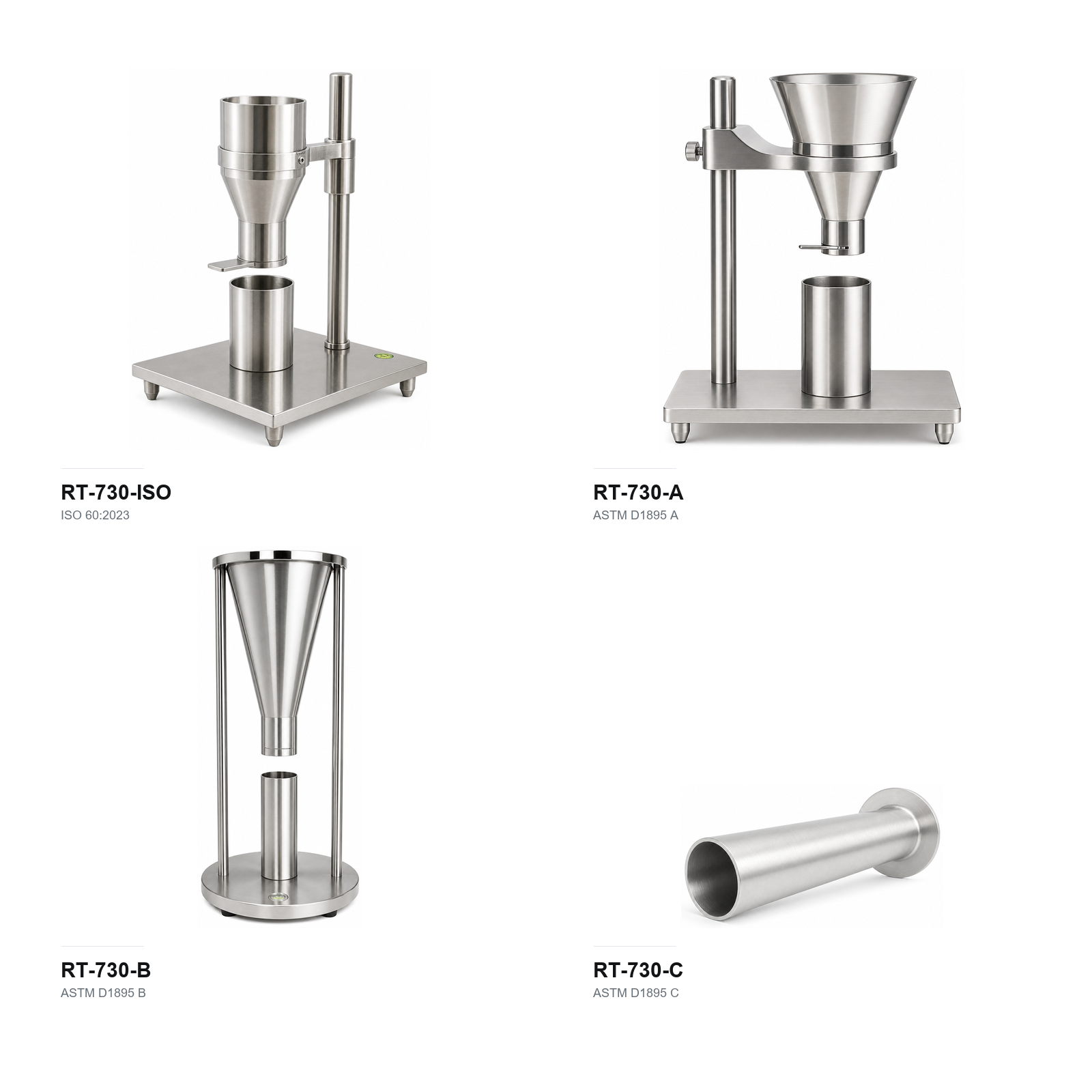
The RT-730 series is available in different configurations for selected test methods under ISO 60:2023 and ASTM D1895. The appropriate configuration depends on the form, particle size and flow characteristics of the material being tested.

Key Benefits
- Multiple configurations for different forms of plastic materials
- Suitable for routine quality control and laboratory testing
- Helps compare apparent density between material batches and suppliers
- Practical apparatus for plastic resin, polymer powder and granule testing
- Configuration selection based on the required test method
- Technical support to help customers select a suitable setup for their materials
1. Testing Standards and Available Configurations
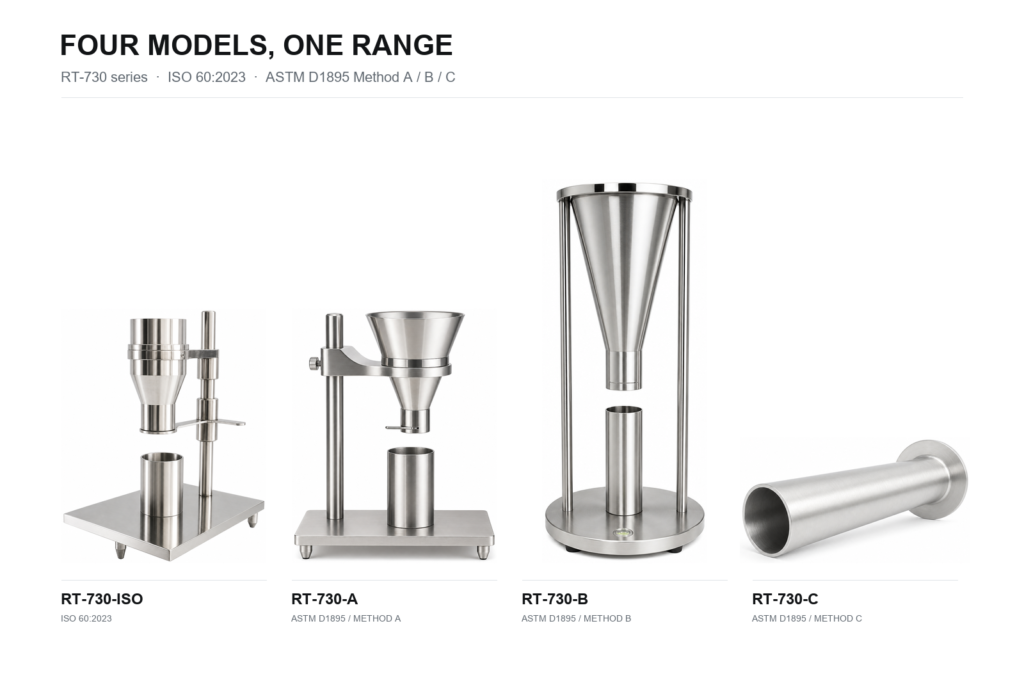
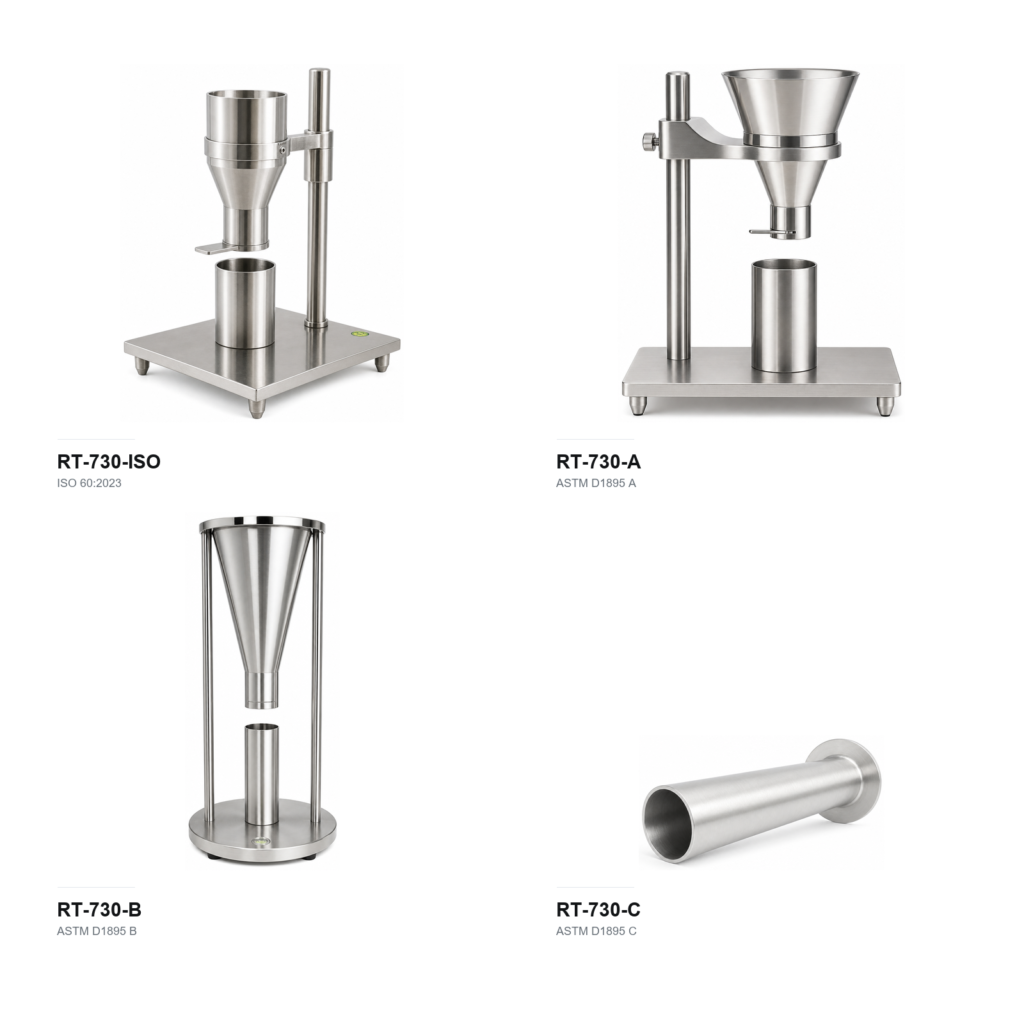
The RT-730 series can be configured for the following testing requirements:
| Model / Configuration | Applicable Test Method | Typical Material Form |
|---|---|---|
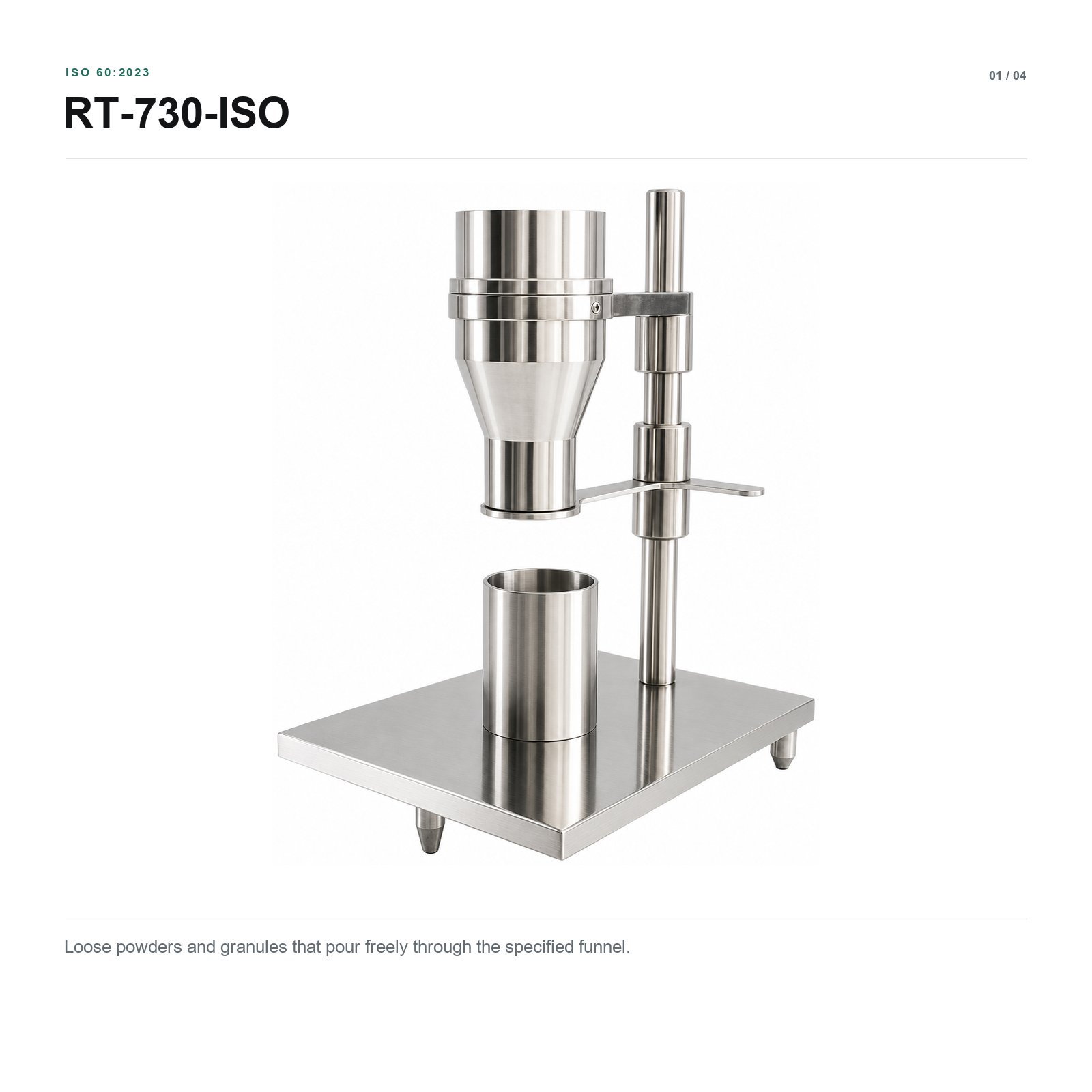
| RT-730-ISO | ISO 60:2023 | Loose powders and granules that can be poured through the specified funnel |
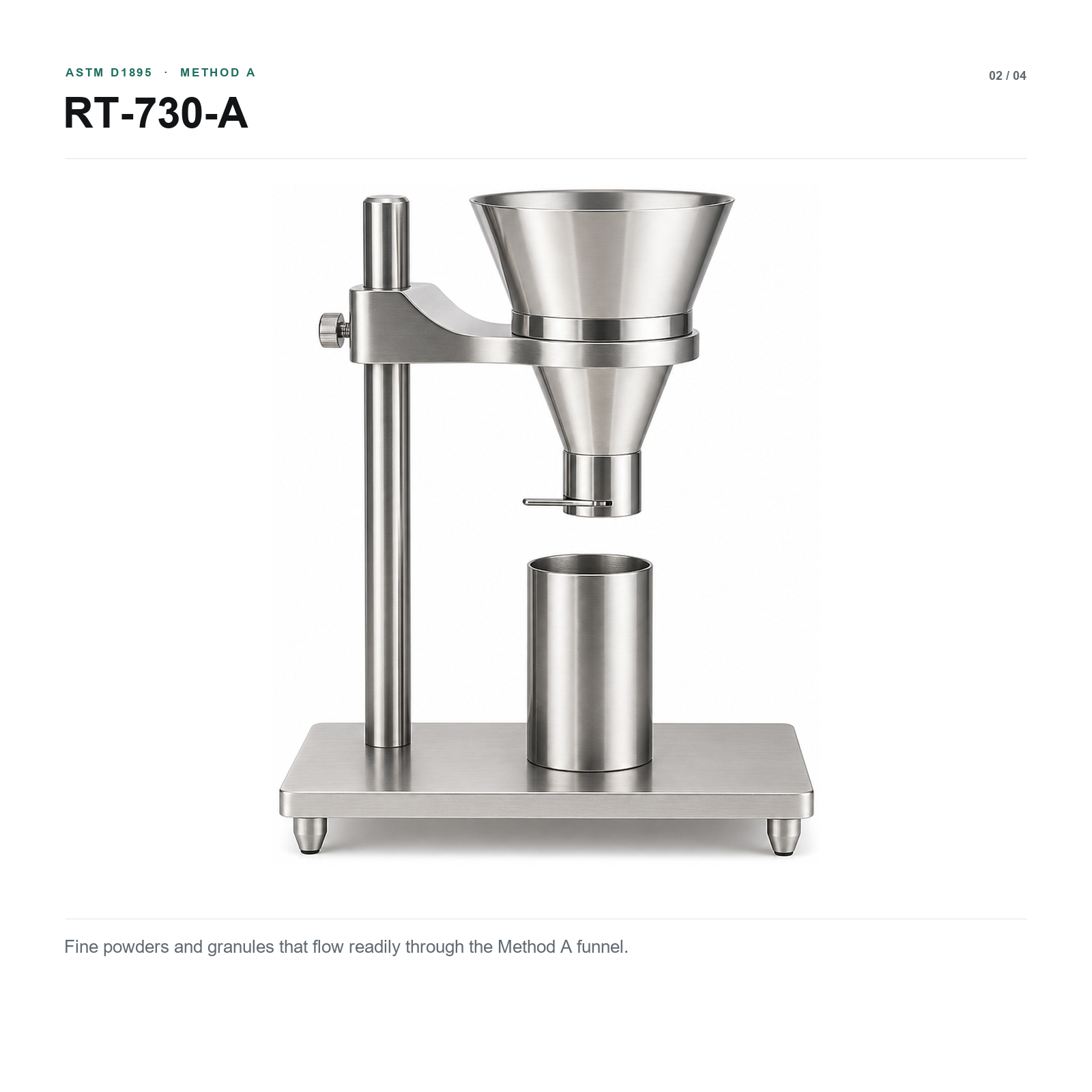
| RT-730-A | ASTM D1895 Method A | Fine powders and granules that flow readily through the Method A funnel |
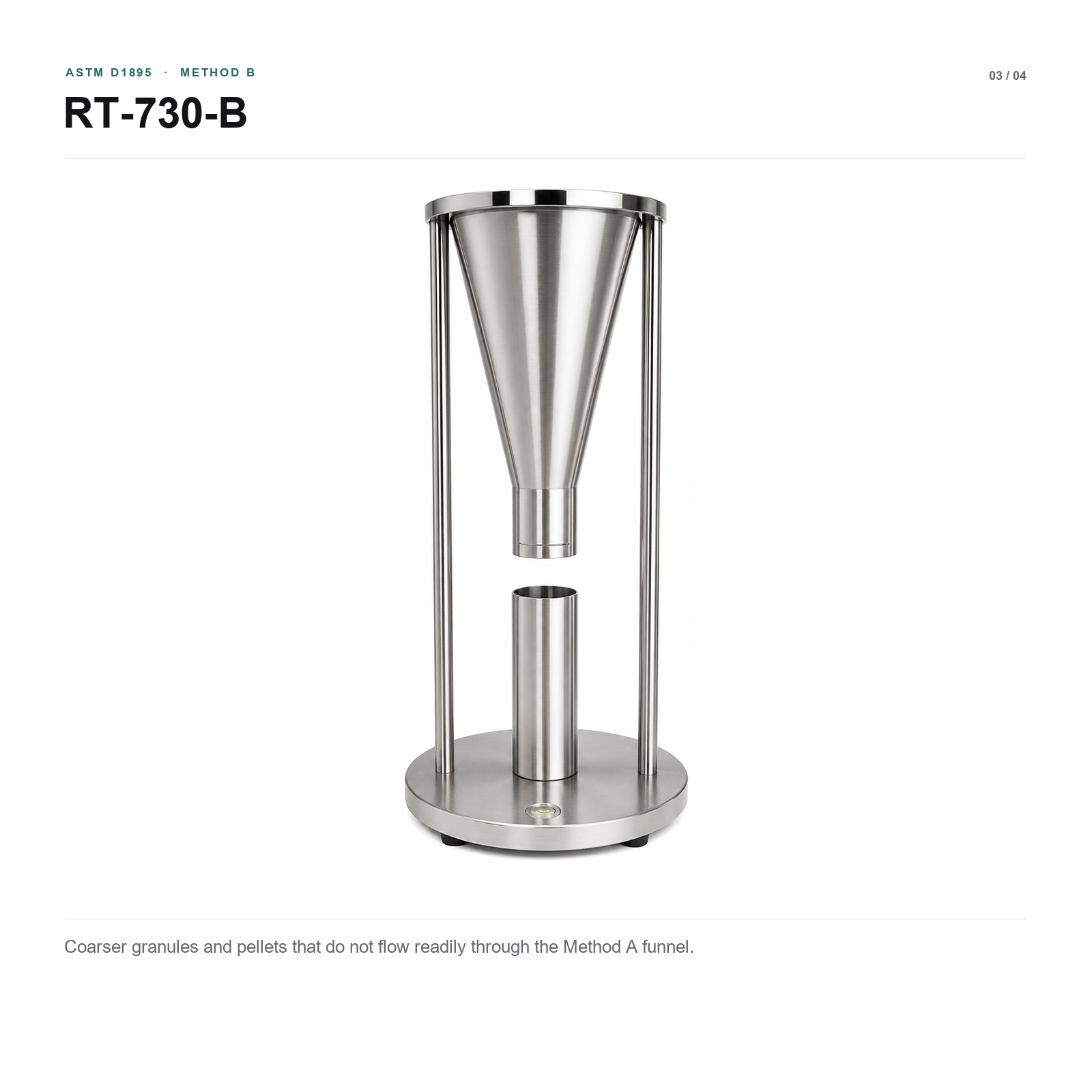
| RT-730-B | ASTM D1895 Method B | Coarser granules and pellets that do not flow readily through the Method A funnel |
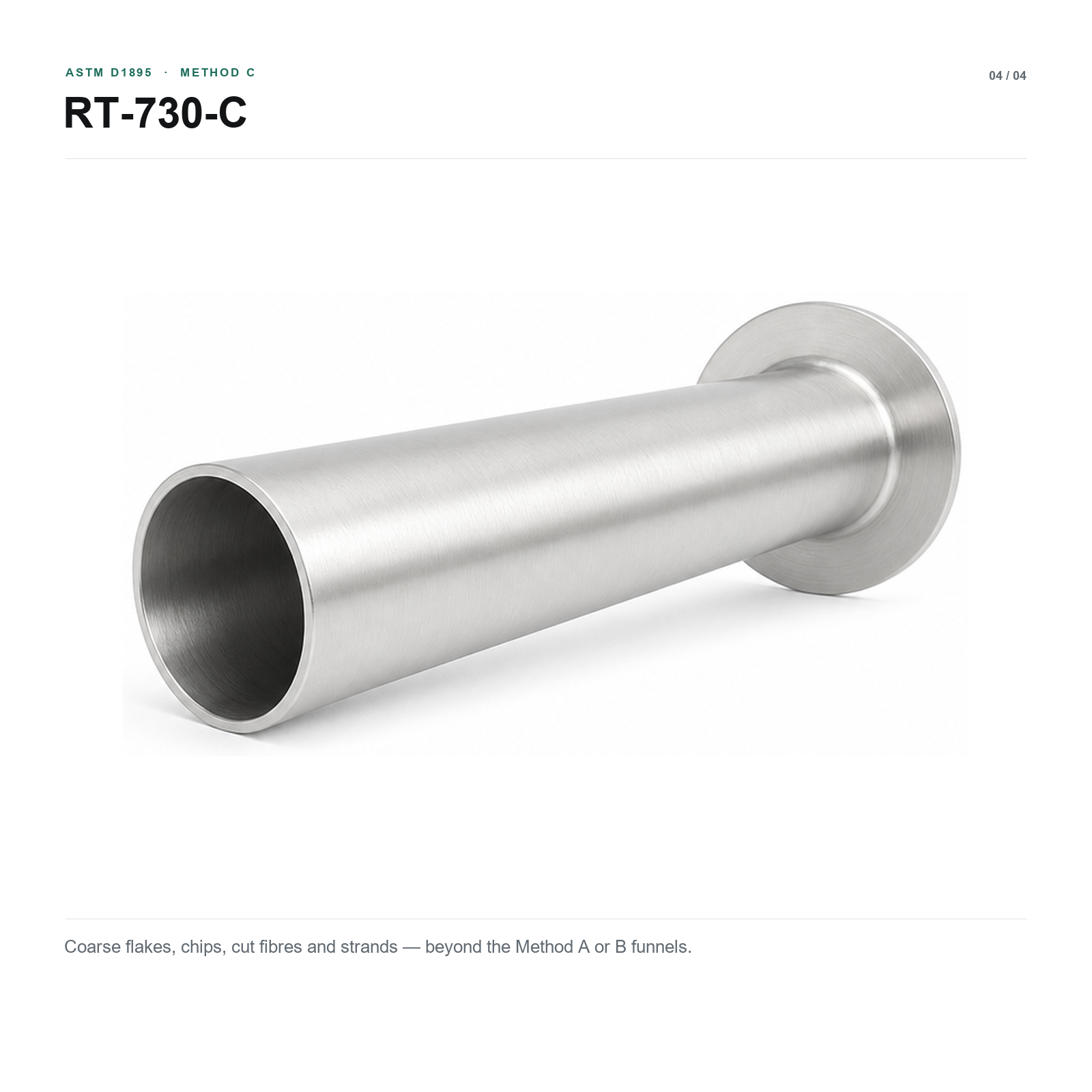
| RT-730-C | ASTM D1895 Method C | Coarse flakes, chips, cut fibers and strands that cannot be tested using the Method A or B funnels |
Important: Test methods are not interchangeable for every material. Please confirm your required standard and material type before ordering so that the appropriate configuration can be selected.
2. Working Principle
The apparent density test determines the mass of a specified quantity or volume of loose material under the conditions defined by the selected test method.
In a typical funnel-based procedure, a representative sample is allowed to flow through a specified funnel into a measuring vessel. The test is performed according to the applicable method, and the measured mass and volume are used to determine apparent density.
For materials that cannot flow readily through the specified funnels, a different procedure may be required. ASTM D1895 Method B and Method C address material forms that are not suitable for the Method A funnel procedure.
The test procedure, vessel, funnel geometry, sample handling and calculation should follow the applicable standard and selected configuration.

3. Product Features
Configurations for Different Plastic Materials
The RT-730 series offers different apparatus configurations for fine powders, free-flowing granules, coarser pellets and bulky plastic flakes or fibers. Selecting the appropriate configuration helps ensure that the test procedure matches the material being evaluated.
Practical Design for Laboratory Testing
The apparatus is intended for routine laboratory and quality-control work. Its funnel, measuring vessel and related accessories are arranged to support the selected test procedure and facilitate regular testing.
Material Quality Control
Apparent density measurements can help laboratories compare plastic raw materials, monitor batch-to-batch variation and support incoming inspection. Results should be interpreted using the same test method and consistent sample preparation conditions.
Support for Standard-Based Testing
The RT-730 series can be supplied in configurations intended for selected ISO 60:2023 and ASTM D1895 testing requirements. Please specify the exact method when requesting a quotation.
Application-Oriented Configuration Selection
Different plastic materials behave differently during pouring and filling. RIGHT can help customers review the material form and required test method before selecting the corresponding apparatus configuration.
Why Choose the RT-730 Plastic Apparent Density Tester?
Product Advantages
1. One-Piece 304 Stainless Steel Funnel
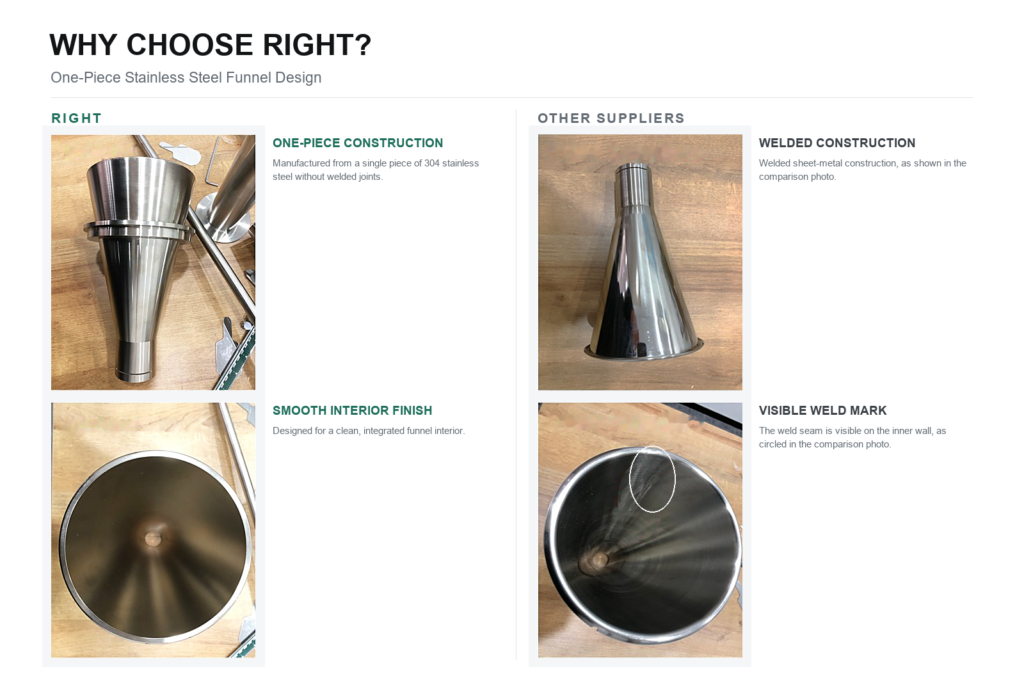
The funnel is manufactured from a single piece of 304 stainless steel without welded joints. Its construction provides a clean, integrated finish, while the funnel geometry is specified for the applicable test configuration.
2. Stainless Steel Measuring Cup with Standard Dimensions
The measuring cup is designed for the specified test procedure, with dimensions and capacity selected according to the applicable configuration. Its stainless steel construction supports routine laboratory use and consistent handling.
3. Attention to Manufacturing Quality
For apparent density testing, the funnel and measuring vessel are important parts of the test setup. RIGHT focuses on component workmanship and dimensional control to help customers use the appropriate apparatus for their testing requirements.
4. Configuration Selection for Your Test Method
Different plastic materials may require different test procedures. By confirming your material type and required standard before ordering, you can select the RT-730 configuration that best matches your application.
4. Technical Specifications

RT-730-ISO — ISO 60:2023 Configuration
| Parameter | Specification |
|---|---|
| Model | RT-730-ISO |
| Applicable standard | ISO 60:2023 |
| Test purpose | Determination of apparent density of loose material that can be poured from a specified funnel |
| Typical materials | Suitable plastic powders and granules |
| Measuring vessel | 100 mL measuring cylinder, subject to the final supplied configuration |
| Measuring cylinder capacity tolerance | Verify against the current standard and supplied apparatus |
| Balance readability / accuracy | Select a balance suitable for the method; confirm the required specification before ordering |
| Funnel geometry | To be confirmed against ISO 60:2023 and the supplied configuration |
| Power supply | Not required for the basic manual apparatus |
| Installation | Benchtop laboratory use |

RT-730-A — ASTM D1895 Method A
| Parameter | Specification |
|---|---|
| Model | RT-730-A |
| Applicable standard | ASTM D1895 Method A |
| Test purpose | Apparent density testing of fine powders and granules that flow readily through the specified funnel |
| Funnel upper diameter | 93 mm |
| Funnel outlet diameter | 9.5 mm + 0.8 mm, as listed in the existing product specification; confirm the intended tolerance format before publication |
| Funnel height | 39.9 mm |
| Distance from funnel outlet to measuring cup opening | 38 mm |
| Measuring vessel | 100 cm³ measuring cup, subject to the supplied configuration |
| Main accessories | Stopwatch, brush and 150 mm steel ruler, as supplied |
| Power supply | Not required for the basic manual apparatus |
| Installation | Benchtop laboratory use |

RT-730-B — ASTM D1895 Method B
| Parameter | Specification |
|---|---|
| Model | RT-730-B |
| Applicable standard | ASTM D1895 Method B |
| Test purpose | Apparent density testing of coarser granular materials that cannot flow, or flow only with difficulty, through the Method A funnel |
| Funnel upper opening | 127 mm + 10 mm, as listed in the existing product specification; confirm the intended tolerance format |
| Funnel outlet diameter | 25.4 mm + 1.6 mm, as listed in the existing product specification; confirm the intended tolerance format |
| Funnel angle | 24°, as listed in the existing product specification |
| Funnel-to-cup distance | 38 mm |
| Measuring cup height | 240 mm + 1 mm, as listed in the existing product specification; confirm the intended tolerance format |
| Measuring cup capacity | 400 mL ± 2.0 mL, as listed in the existing product specification |
| Material | Stainless steel, subject to the supplied configuration |
| Main accessories | Confirm according to the selected configuration |
| Power supply | Not required for the basic manual apparatus |
| Installation | Benchtop laboratory use |

RT-730-C — ASTM D1895 Method C
| Parameter | Specification |
|---|---|
| Model | RT-730-C |
| Applicable standard | ASTM D1895 Method C |
| Test purpose | Apparent density testing of bulky plastic materials unsuitable for the Method A or B funnel procedures |
| Typical materials | Coarse flakes, chips, cut fibers and strands |
| Measuring vessel | Graduated cylinder / specified measuring assembly, according to the supplied configuration |
| Measuring capacity | Confirm the supplied cylinder capacity before publication |
| Loading components | To be supplied according to the selected Method C configuration |
| Material | Confirm according to the supplied configuration |
| Power supply | Not required for the basic manual apparatus |
| Installation | Benchtop laboratory use |
Specification note: The dimensions above are taken from the existing product information where available. Before publishing, verify all dimensions, tolerances, vessel capacities and accessory lists against the actual apparatus and the exact edition of the required standard. Do not claim full compliance based on model names alone.
5. Applications
The RT-730 series can be used in laboratories and manufacturing facilities that inspect plastic raw materials and polymer processing materials.
Typical applications include:
- Plastic resin powders
- Polyethylene (PE) and polypropylene (PP) granules
- PVC compounds and powders
- Engineering plastic pellets
- Polymer masterbatch granules
- Plastic flakes and chips
- Cut polymer fibers and strands
- Other loose plastic molding materials suitable for the selected method
The correct test configuration depends on the material’s form and flow characteristics. Please share your sample details and testing standard when requesting a recommendation.
6. How to Select the Right Configuration
| Your Material or Requirement | Recommended Configuration | Selection Notes |
|---|---|---|
| Fine powder that flows readily through a small specified funnel | RT-730-A | For ASTM D1895 Method A |
| Free-flowing plastic powder or granules tested to ISO 60:2023 | RT-730-ISO | Confirm the current standard-specific apparatus and procedure |
| Coarser resin granules or pellets that do not flow readily through the Method A funnel | RT-730-B | For ASTM D1895 Method B |
| Coarse flakes, chips, cut fibers or strands unsuitable for the A/B funnel procedures | RT-730-C | For ASTM D1895 Method C |
| Testing according to a customer-specific or laboratory procedure | Confirm with RIGHT | Provide the standard number and material details before ordering |
If you are unsure which model is suitable, send us the material name, sample form and required test standard. Our team can help you identify the appropriate configuration.
7. Typical Testing Workflow
The exact procedure depends on the selected standard and apparatus. A typical laboratory workflow includes:
- Confirm the test method. Select the appropriate configuration based on the required standard and material form.
- Prepare the sample. Follow the sample preparation and conditioning requirements specified by the applicable method.
- Prepare the apparatus. Check that the funnel, measuring vessel and accessories are clean and correctly assembled.
- Carry out the test. Introduce the sample and complete the measurement according to the selected method.
- Determine apparent density. Use the measured mass and the specified volume or calculation procedure.
- Record the result. Document the test method, sample identification and result for traceability and comparison.
For reliable comparisons, use the same method and consistent test conditions when evaluating different batches or suppliers.
8. Why Measure Plastic Apparent Density?
Apparent density is useful for understanding how loose plastic materials occupy space before they are processed or compacted under manufacturing conditions.
It can help users:
- Compare the bulk handling characteristics of different plastic raw materials
- Check consistency between incoming material batches
- Support material selection and supplier evaluation
- Understand storage, packaging and feeding considerations
- Maintain laboratory records for routine quality control
Apparent density is not the same as the true density or solid density of the polymer. The result depends on the test method and the way the loose material occupies the measuring volume.
9. Frequently Asked Questions
What is a plastic apparent density tester used for?
It is used to determine the apparent density of loose plastic materials, such as powders and granules, using a specified test procedure. Different configurations may be needed for coarser pellets, flakes, chips or fibers.
What is the difference between ASTM D1895 Methods A, B and C?
Method A is intended for fine powders and granules that flow readily through its specified funnel. Method B is used for coarser granular materials that do not flow, or flow with difficulty, through the Method A funnel. Method C covers bulky materials such as coarse flakes, chips, cut fibers and strands that are unsuitable for the Method A and B funnel procedures.
Is ISO 60:2023 the same as ASTM D1895 Method A?
ASTM D1895 identifies Method A as equivalent to ISO 60 in its standard notes. However, users should follow the applicable edition and the exact requirements of the standard they need to meet. Do not assume that every apparatus dimension from an older edition automatically applies to ISO 60:2023.
Can one configuration test all types of plastic materials?
Not necessarily. The material’s particle size, shape and flow behavior affect the appropriate procedure. Selecting the correct configuration helps the test match the required method.
What is the difference between apparent density and true density?
Apparent density relates the mass of a loose material to the volume it occupies under the specified test conditions. True density refers to the density of the material itself and excludes the interparticle void space in a loose sample. They are different measurements and should not be used interchangeably.
What information should I provide when requesting a quotation?
Please provide the material name, sample form, required standard and any specific laboratory procedure. If you already use a particular funnel or measuring vessel, you can also share its specification so that the configuration can be checked before ordering.
10. Request a Quote for the RT-730 Plastic Apparent Density Tester
Looking for an apparent density tester for plastic powders, granules, pellets or flakes?
RIGHT supplies laboratory testing instruments for material quality control and testing applications. Tell us which standard you need to follow and what type of material you test, and we can help you identify the suitable RT-730 configuration.
Contact us for:
- Product and configuration details
- Technical specifications
- Quotation and delivery information
- Accessory and testing-method confirmation
Contact RIGHT today to discuss your plastic apparent density testing requirements.

RIGHT's Services Always Go Extra Mile
No more endlessly wasting time on other lousy suppliers. RIGHT's goal is to let you sit back and relax. We take care of all the dirty works, including trade stuff, clearance and logistics, etc. Our consultant will keep you informed of the trade progress throughout.
Related products
-

Free-Falling Dart Impact Tester for Plastic Films & Packaging Material (RT-720)
-
RT-719 Digital Bottles Cap Torque Testing Machine
-
RT-706 2000mm Height Falling Ball Impact Testing Machine
-
RT-129B Pneumatic Mini Table Plastic Injection Molding Machine
-

RT-129B Small Pneumaitc Injection Molding Machine
-
RT-129 Small PP PVC Injection Molding Machine
-
RT-703C 5J Digital Charpy Impact Tester
-

RT-701B Plastic Melt Flow Rate Index Tester